
Quick note before we start: this is general info, not medical advice. If you have a heart condition, diabetes, or you’re on medication, talk to your doctor or a dietitian before you overhaul how you eat.
The diet that never really goes out of style
Every year there’s a new diet. Keto had its moment. Carnivore had its moment. Some powder or 30-day reset is always trending.
And then there’s the Mediterranean diet. Just… still there. Quietly topping the lists, year after year, while everything else comes and goes.
I think that’s the first clue it’s worth paying attention to. Fads need hype. This one doesn’t. It’s been studied for decades, and the people who actually live this way — in places like Sardinia in Italy and Ikaria in Greece — are the ones showing up in all those Blue Zones stories about people living past 90, still gardening, still walking to the market, still eating dinner with their family.
No, it’s not a magic diet. And no, olive oil alone won’t add ten years to your life. But the pattern? The pattern is hard to argue with.
So what is it, really?
Forget the pyramid for a second. Here’s the short version.
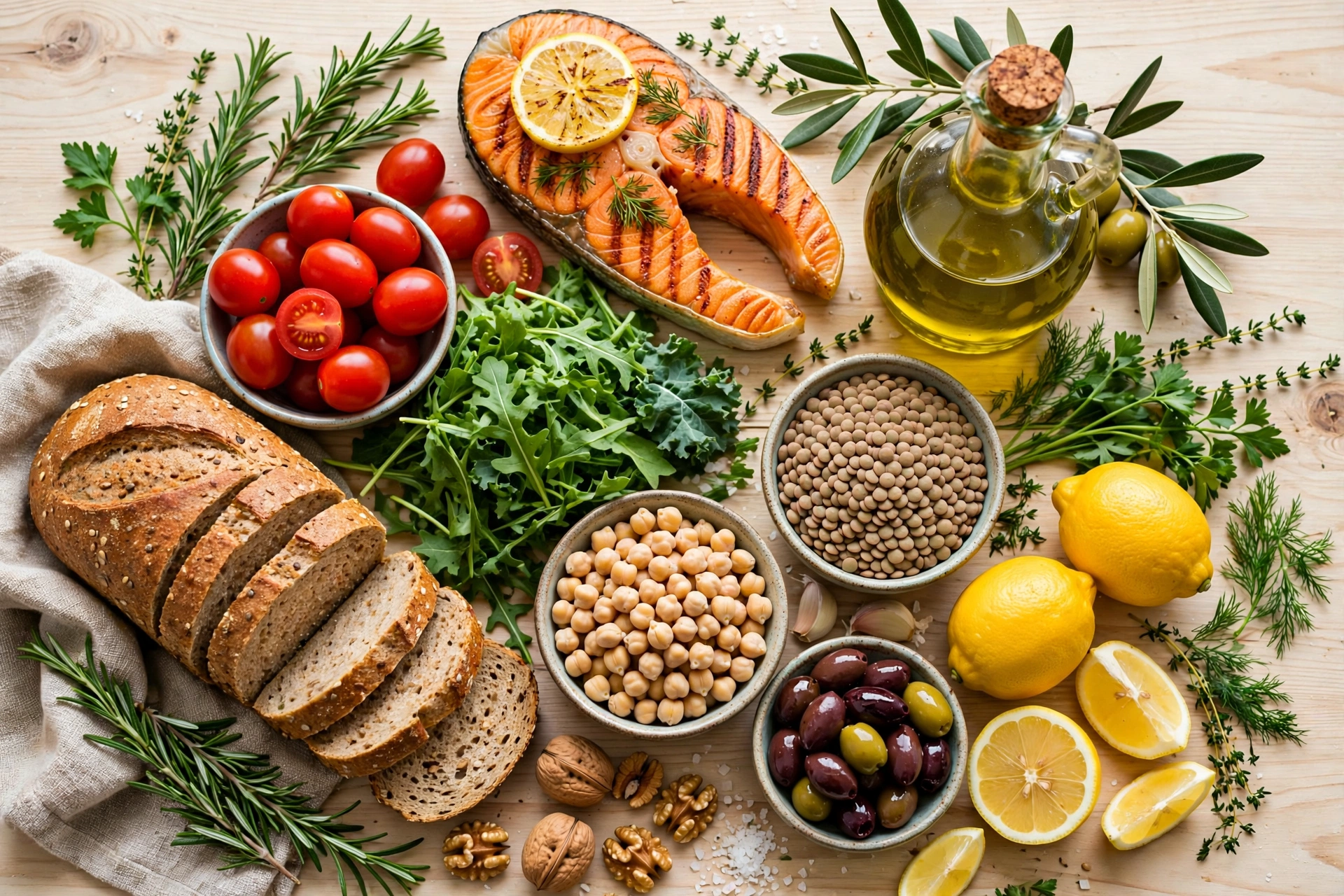
Plants most of the time. Fish a few times a week. Olive oil instead of butter. Beans, lentils, whole grains, nuts, fruit — the everyday stuff, not the fancy stuff. Red meat rarely. Sweets rarely. And meals that are, you know, actual meals. Sitting down. With people. Not eating lunch over your keyboard.
That’s it. That’s the whole diet. There’s no app, no points, no 30-day challenge. Which is probably why it actually lasts.
The Cleveland Clinic puts it in plain numbers, and I like plain numbers: fruit about 3 servings a day, vegetables 3 or more, whole grains 3 to 6 servings a day, extra-virgin olive oil 1 to 4 tablespoons a day, legumes about 3 servings a week, fish about 3 servings a week, nuts at least 3 servings a week. Poultry and eggs in moderation, dairy a little, red meat once a week at most, if that.
Read that list again. Nothing weird on it. Nothing you have to order from a special website. It’s just… normal food, in a sensible order.
Why do scientists keep coming back to it?
Okay, the honest version: a lot of this research is observational. Scientists watch large groups of people for years, see who eats this way and who lives longer, and try to untangle everything else going on in their lives. That’s not the same as a lab experiment. It can’t prove one food caused a longer life.
But the signal keeps showing up, in study after study, and that’s hard to ignore.
The big one is PREDIMED, a trial in Spain with more than 7,400 people at high heart risk. The Mediterranean diet groups — one with extra olive oil, one with extra nuts — had roughly 30% fewer major heart events than the low-fat group. Heart attacks, strokes, deaths from heart disease. That’s a real trial, not just a survey.
Then there’s the Nurses’ Health Study — over 25,000 women followed for up to 25 years. The women who stuck closest to this way of eating had up to 23% lower risk of dying from any cause, and 46% greater odds of what researchers call “healthy aging”: making it past 70 without major chronic disease or serious physical, mental, or cognitive decline.
And a 2026 pooled analysis — 54 studies, more than 1.8 million people — found each one-point increase in a Mediterranean diet score was linked to about 4% lower risk of dying from any cause.
Is it perfect evidence? No. The strongest part is heart health. The brain stuff — lower Alzheimer’s risk, slower cognitive decline — looks promising, but it’s messier. Cancer findings vary. Anyone who tells you this diet guarantees a long life is selling you something.
But as a pattern for living longer and feeling better while you do it? It’s the best-supported one we’ve got.
The foods that do the heavy lifting
Let’s not make this a textbook. A few foods carry most of the weight here.
Olive oil first, obviously. Extra-virgin, the good stuff. It’s mostly monounsaturated fat, plus polyphenols — those plant compounds that help with inflammation. Use it instead of butter. Drizzle it on salad, on cooked veg, on bread. One to four tablespoons a day is the usual guidance, and honestly, that’s easy once you stop saving it for special occasions.
Fish next. Salmon, sardines, mackerel, tuna, herring — the oily ones with omega-3s. Three times a week, a palm-sized piece, 3 to 4 ounces. Sardines are the unsung hero here, by the way. Cheap, no cooking drama, and stupidly nutritious. If fresh fish feels expensive or fiddly, canned sardines and tuna count.
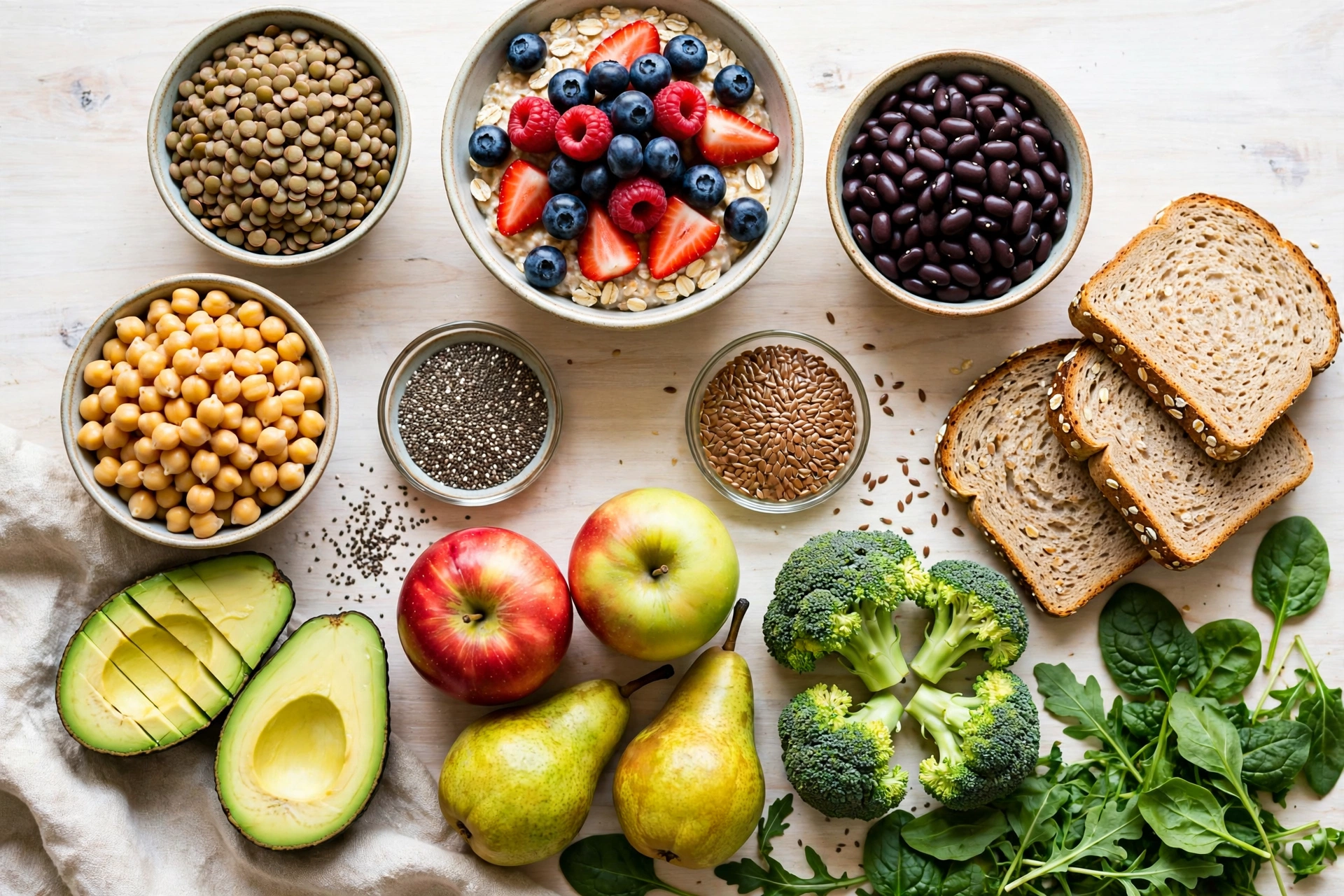
Then beans and lentils. This is where the Mediterranean diet quietly overlaps with the fiber stuff — and if you read the fibermaxxing post, you already know why that matters. Lentils, chickpeas, black beans: cheap, filling, full of fiber and plant protein. Hummus counts. Bean soup counts. A lentil salad you make on Sunday and eat all week counts double.
Whole grains: oats, brown rice, quinoa, barley, whole-wheat bread and pasta. Not the white, stripped-down versions. The point isn’t to fear carbs. It’s to eat the version that still has its fiber intact.
And fruit and veg, obviously. Tomatoes, leafy greens, broccoli, carrots, peppers, onions, garlic, berries, apples, pears, citrus. Three-plus servings of veg a day sounds like a lot until you realise a big salad at lunch and veg with dinner basically gets you there.
Nuts: walnuts, almonds, hazelnuts. A small handful, a quarter cup, a few times a week. Great snack, great on yogurt, great in a salad. Just go for raw or dry-roasted, unsalted, not the honey-coated ones.
What it doesn’t include (much)
Red meat: once a week at most. Not never, just not the centre of every dinner.
Processed meat, sugary drinks, refined white bread and pastries, lots of butter and cream, ultra-processed snacks: these are the “rarely” foods. Again, not banned forever. Just not daily.
Alcohol? Traditionally a small glass of wine with a meal, not a Friday-night blowout. And honestly, if you don’t drink, don’t start for the diet. The food does the work.
A week that actually works
Not a perfect week. A doable one.
Breakfast most days: Greek yogurt with berries and walnuts. Or oats with fruit. Or eggs with whole-grain toast and tomatoes. Five minutes, no drama.
Lunch: a big salad — greens, chickpeas, cucumber, tomato, feta, olive oil and lemon. Or lentil soup with whole-grain bread. Or leftovers from last night, which is the real Mediterranean secret nobody talks about. Cook once, eat twice.
Dinner: grilled salmon, brown rice, and broccoli on Monday. Pasta with tomato, garlic, white beans, and spinach on Tuesday. Chicken with roasted veg and quinoa on Wednesday. A bean stew on Thursday. Fish again on Friday, because that’s the routine.
Snacks: an apple and almonds. Carrots and hummus. A pear. Fruit, basically, instead of a vending machine bar.
See the pattern? No calorie counting. No weighing. Just: plants at every meal, fish a few times a week, olive oil as your main fat, beans and whole grains doing the filling-up work.
The part nobody puts on the food pyramid
Here’s the bit I almost skipped, and I’m glad I didn’t.
In Sardinia and Ikaria, people don’t just eat this way. They walk everywhere. They garden. They eat with family. They nap, sometimes. They have a purpose and people around them.
You can’t buy that in a bottle of olive oil. And a diet that only works if you’re stressed, lonely, and eating alone at your desk is a diet that won’t work for long.
So if you take one thing from this post, let it be this: cook something simple, sit down, and eat it with someone if you can. That counts. It genuinely counts.
The mistakes people make
One: turning it into an expensive shopping list. You don’t need imported everything. Canned beans, frozen veg, supermarket olive oil, tinned sardines — all fine. The diet was built on peasant food, not luxury imports.
Two: drowning everything in olive oil and calling it healthy. It’s good fat, but it’s still fat, still calories. A drizzle, not a flood.
Three: eating pasta every night and skipping the veg and beans. Pasta is in the diet, yes, but it’s a side player, not the whole show. Half the plate plants, remember?
Four: expecting results in two weeks. This isn’t a 30-day reset. The studies followed people for years. The benefit builds slowly — better blood pressure, better cholesterol, better blood sugar, over months and years. Boring? A bit. True? Yeah.
Five: treating it like a strict diet and then quitting when you have pizza one night. One pizza doesn’t undo it. It’s the pattern over months that matters, not a single meal.
Last thing
I keep coming back to this: the Mediterranean diet isn’t exciting, and that’s exactly why it works.
No forbidden foods. No magic ingredient. Just plants, fish, beans, whole grains, olive oil, and meals you actually enjoy — done most days, for years.
Don’t try to change everything this week. Pick one thing. Swap butter for olive oil. Add beans to one meal a day. Fish twice this week instead of red meat. One thing.
Start there. The people in the Blue Zones didn’t get there by doing a perfect diet for a month. They got there by eating like this, more or less, for a lifetime — and enjoying it.
This post is general information only and is not medical advice. It does not replace advice from a qualified healthcare professional or registered dietitian.